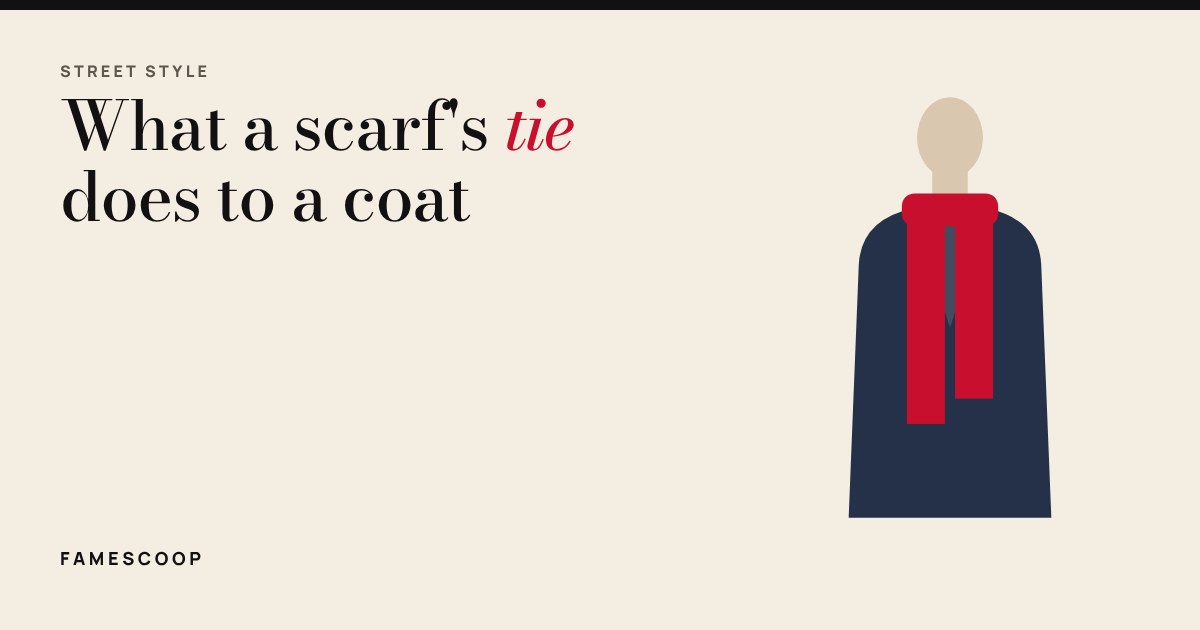
The same scarf, three different outfits
A scarf is the smallest piece in a winter outfit and the one that changes the most. Put the same scarf on the same coat in three different ways and you get three different necklines: a long vertical line, a thick soft collar, or a small neat knot. Nothing was bought or swapped. Only the tie changed.
That is why street-style photographs of cold-weather outfits so often hinge on the scarf. It sits right under the face, it adds a colour or a texture exactly where the eye lands first, and it decides how much of the coat's front stays visible. This piece explains the three most useful ties, shows what each does, and lets you test them on a coat and scarf of your own colours.
Three ties, one idea: how far the scarf drops
Forget the names for a moment and think about one number: the drop, meaning how far the scarf hangs down the front of the coat, measured from the collarbone. A long drop makes a strong vertical line and covers the coat's front. A short drop keeps attention at the neck and leaves the coat's buttons and lapels visible.
- Draped. Hang the scarf around the neck with both ends falling straight down the front. It uses almost the whole length, so the drop is the longest. It is the easiest tie and works with any coat that is open or has lapels.
- Looped. Wrap the scarf once around the neck and let the ends hang. The wrap eats up roughly 40 cm of length and builds a soft, thick collar close to the face. The drop is shorter and the volume sits high.
- Parisian knot. Fold the scarf in half lengthwise, lay it around the neck, and pull both loose ends through the loop. It is also called the European loop. The drop is the shortest, and the result is flat and tidy.
Match the tie to the coat's neckline
The coat decides which tie works, because the scarf has to fit into whatever the collar leaves open.
Tailored coats with lapels such as trench coats, wool overcoats and blazers look best with the Parisian knot or a short draped scarf tucked inside the lapels. The lapel is a feature of the coat, and a short drop leaves it visible. A thick looped scarf on top of a lapel competes with it for attention.
Collarless or funnel-neck coats have a gap at the neck that a looped scarf fills nicely. The volume sits where the coat has none.
Puffers and other padded coats already carry volume at the chest. A long draped scarf in a thin fabric keeps the outline clean; a chunky loop on top tends to look heavy.
If the coat has a lot going on at the neck, shorten the drop. If the neck is empty, let the scarf fill it.
Colour and fabric: where the scarf does the work
Because the scarf sits closest to the face, it is the easiest place to repeat or break the colours of an outfit. A scarf in a neighbouring shade of the coat gives a quiet, tonal look. A scarf in one clear contrast, such as ivory on a navy coat or red on grey, makes the neck the focal point. Use the colour buttons in the figure above to see both effects.
Fabric changes how a tie behaves. A fine merino or a wool-and-silk blend drapes in clean lines and makes a neat Parisian knot. A thick cable knit holds a loop and keeps its shape but turns bulky when knotted. A fringed end adds a casual detail; a plain hemmed end looks more precise.
When to break the rules
The estimates above are starting points. A scarf pulled tight reads shorter than one worn loose, and some people like the look of ends tossed over one shoulder or left uneven on purpose. If a tie looks right in the mirror, it is right. The point of knowing the drop is that you can adjust it deliberately instead of by accident: tuck an end in to shorten the line, or let it hang to lengthen it.
You also do not need a new scarf to try this. Re-wearing the one you already own in a different tie is the cheapest outfit change there is, and second-hand scarves in wool or cashmere blends are easy to find.
What to look for
- Length of about 170 to 200 cm. Shorter scarves can only be draped or knotted; longer ones allow a full loop.
- A fibre that drapes. Merino, a wool blend or cashmere blend holds a knot without becoming stiff. Check the label for the fibre mix.
- A colour that repeats something you already wear. One shade of your coat or one shade of your trousers makes the scarf easy to reuse.
- A weight that suits your coats. A thin scarf works under a tailored coat; a thick one needs space at the collar.