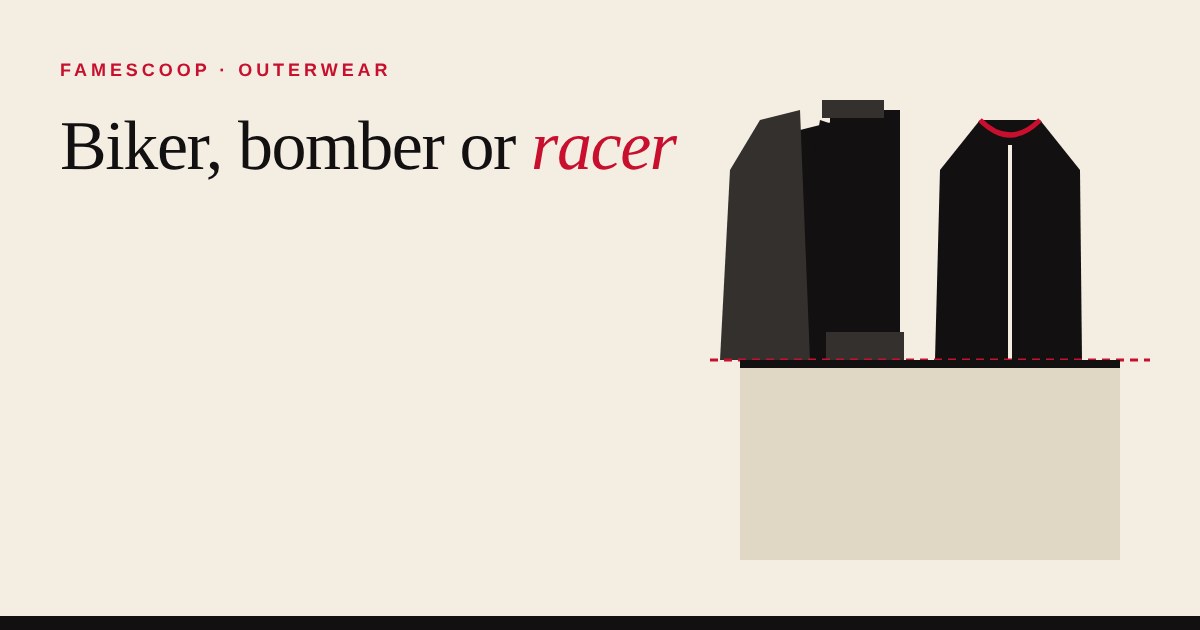
One jacket, three very different outlines
A black leather jacket is one of the few pieces that almost everyone owns, or wants. Yet two leather jackets can change an outfit in opposite ways. One makes the legs look longer and the outfit sharper. The other makes everything look softer and more relaxed. The material is the same. What differs is the cut: where the hem stops, how the collar sits and how wide the shoulder is.
Three cuts cover most of what you will find in shops: the biker, the bomber and the racer. Try them below. Pick a cut, then move the waistband of the trousers underneath it and watch what happens at the hem.
The biker: short, sharp and a little bit of attitude
The biker jacket goes back to the Perfecto, which the American maker Schott introduced in 1928 as a heavy leather motorcycle jacket with an asymmetrical front, so the closure sat off-centre to block the wind. Today the shape is a style by itself: a short body, lapels that fold back, an off-centre zip and a firm shoulder. Because it ends near the waist, it works with high-waisted trousers or a long skirt, where the short hem makes the lower half look longer.
The bomber: soft and round
The bomber traces to military flight jackets, such as the leather A-2 the US Army Air Corps wore in the early 1930s. Its signature is the knitted band at the collar, cuffs and hem. The band pulls the jacket in around the hip, so it sits in a soft block rather than a sharp line. It looks best with straight or wide trousers, where the round hem and the clean leg echo each other.
The racer: the quiet one
The racer has no collar, no lapel and almost no detail: a plain front with a straight hem, often only a zip and one or two pockets. That restraint is the point. It works over a shirt, a fine knit or a dress without competing with any of them, and it is the one to choose if you want a leather jacket that goes with everything you already own.
The material gives the attitude. The cut decides what the rest of the outfit does.
Real, faux and second-hand
Real leather ages: it softens and creases around the elbows over the years. Faux leather costs far less and is a fine way to test a cut before you commit, but it does not age the same way and is usually thinner. Second-hand leather jackets are plentiful, so check what is already in your family's wardrobe or in a vintage shop before you buy new. Whichever you choose, wear what you have again before you add something new.
What to look for
- Shoulder seam on the shoulder. If the seam sags down the arm, the whole jacket looks borrowed. Oversized is a style choice only when the sleeves are long enough and you mean it.
- Hem that meets your trousers on purpose. Try it with the waistband you wear most. Either land on it or clear it by a hand's width; a hem that stops a few centimetres short looks like an accident.
- Sleeves that reach the wrist bone when your arms are relaxed, and can bend without pulling the back.
- Plain hardware and a matt or soft sheen. Black, dark brown and oxblood go with almost everything; a very glossy finish is harder to pair.
Leather jackets for sale run from around €50 for a faux version to several hundred euros for real leather.