Eyewear ·
Full-Rim, Half-Rim or Rimless: What a Frame's Rim Does to an Outfit
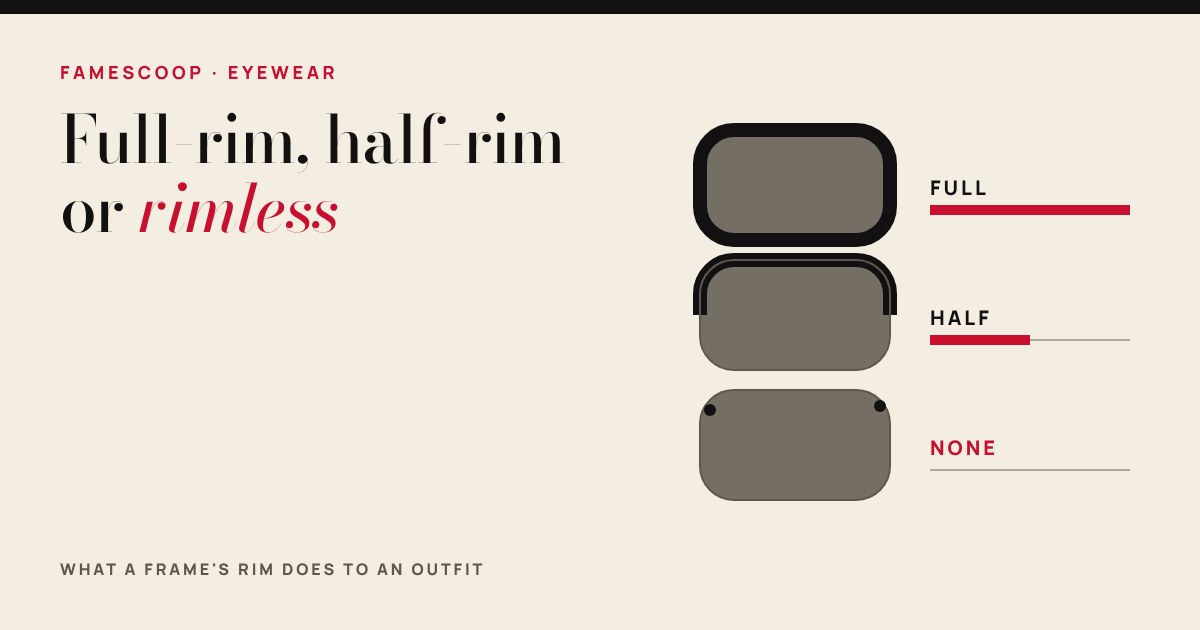
Most advice about sunglasses is about shape and colour, but how much rim sits around the lens changes an outfit just as much. A full-rim frame draws a complete outline, a half-rim frame adds a bar over the brow, and a rimless pair leaves only the lens.
This piece explains how each build is made, why it matters for the lines already near your face (collar, knit, hat), and what to know about durability. Try the three rims against three necklines in the interactive.
Is the frame a line, or is it gone?
Most talk about sunglasses is about shape and colour. This piece is about something simpler: how much of the lens has a rim around it at all. The rim is the strip of frame that wraps the lens edge, and it comes in three builds. A full-rim frame surrounds the lens completely. A half-rim frame (also called semi-rimless) frames only the top of each lens. A rimless pair has no frame around the lens at all.
The build matters for an outfit because a frame is a line across the upper part of your look, in the same way a collar or a hem is a line. Take the rim away and you take the line away. Whether that is good depends on how many other lines your outfit already has.
The three builds, in plain words
In a full-rim pair, the lens sits in a groove inside a closed frame. It is the most common build in sunglasses, it protects the lens edge, and it comes in the widest range of shapes, colours and materials. As a line it is complete: a clear outline around each lens.
In a half-rim pair, the top of each lens is framed and the bottom edge is held by a thin nylon cord that sits in a small channel cut into the lens. From a few steps away you see a bar over the brow and a lens that fades into the face below. The line is there, but only on top.
In a rimless pair, small pieces of hardware are fixed straight to the lens through drilled holes, and the bridge and arms attach to that. You see the lens itself, edge and tint, and almost nothing else. There is no outline, so the colour of the lens does the job the frame would have done.
What each build does to an outfit
| Build | What you see | Works well with |
|---|---|---|
| Full-rim | A complete outline round each lens | Plain tops and simple outfits, where the frame is the one strong line |
| Half-rim | A bar over the brow, a soft lower edge | Collars, jackets and anything with a horizontal line near the neck |
| Rimless | Lens tint and edge, hardly any frame | Loud knits, big collars and patterns that should lead |
A useful way to use this: count the strong lines already in your outfit near the face. A bold collar, a rolled neck, a scarf, a hat brim. If there are two or more, a rimless or half-rim pair keeps the look from getting crowded. If there are none, a full-rim pair gives the outfit a point of focus.
The practical side
The less frame there is, the more the lens does the work. A rimless pair with a pale lens looks very different from the same build with a dark one, because the tint is now the shape you see. Colour matters more here than on a full-rim pair.
Durability changes too. A full-rim frame protects the lens edge and is the easiest to repair. A half-rim pair has an exposed lower edge that can chip, and the nylon cord stretches over time, so it typically needs replacing every one to three years, a small and cheap job for an optician. Rimless is the most delicate: the stress sits on the drilled holes, screws can work loose, and a dropped lens can crack. If you are hard on your glasses or you are buying for sport, full-rim is the safe choice.
Your own wardrobe is the better guide than any rule. If you already own a pair, try it with the three necklines in the interactive above and see which of your own tops it suits. Second-hand sunglasses are a fair way to try an unfamiliar build before spending much.
Count the strong lines near the face. Then add one, or take one away.
When to break the rule
Two strong lines are not always a mistake. A crisp collar with a full-rim frame is a classic, deliberate pairing, and a plain tee with rimless glasses can be exactly the quiet look you wanted. Treat the idea as a starting point and trust the mirror over the diagram.
What to look for
- Build first. Decide how much frame you want in the look before you think about shape or colour.
- Lens tint on rimless pairs. With no rim, the lens colour is the main thing people see.
- Where it will be worn. Daily and active use points to full-rim, calm and occasional use leaves room for half-rim or rimless.
- Repairs. Check that an optician can replace a cord or a screw before you commit to a delicate build.