Eyewear ·
Grey, Brown, Green or Yellow: What Sunglass Lens Colour Does to a Look
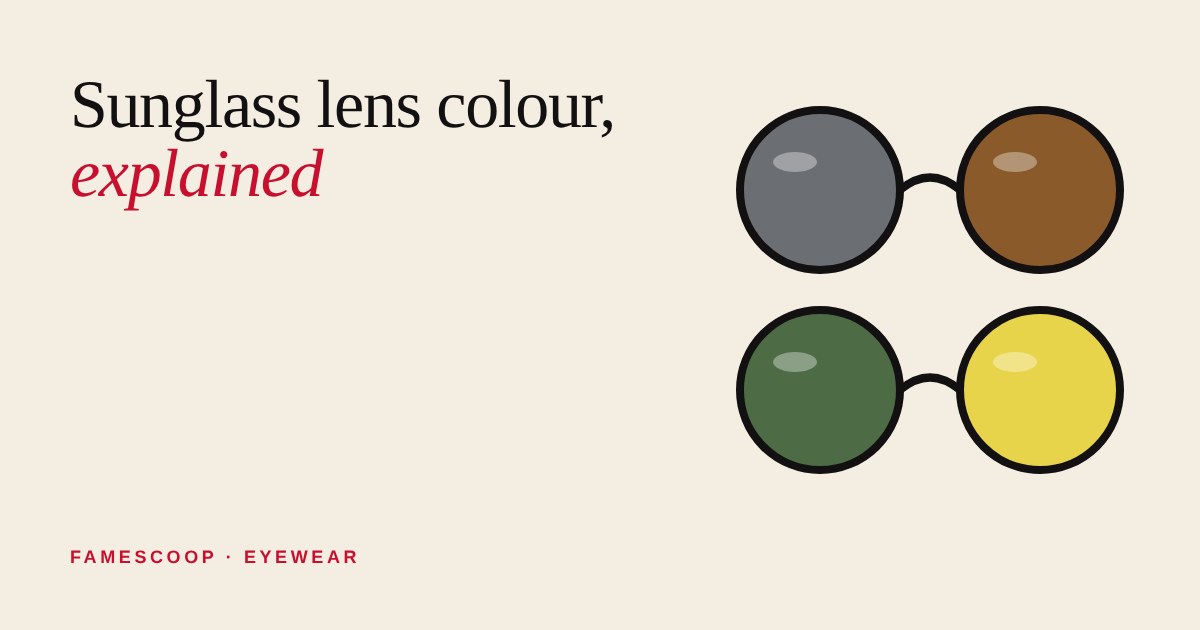
Sunglass lens colour does two jobs: it changes how the world looks to you and how your glasses look to everyone else. Grey keeps colours true, brown warms and sharpens, green is the vintage in-between, and yellow is for dull light.
Try each tint at four darkness levels in sun and cloud, then learn why UV protection has nothing to do with colour.
The colour you see through is part of the look
Most people pick sunglasses by frame shape and never think about the lens. Yet the lens is the part that sits right in front of the eyes, and its colour does two jobs at once: it changes how the world looks to you, and it changes how the glasses look to everyone else. A dark grey lens reads sharp and graphic. A soft brown reads warm. A pale green reads vintage. A light yellow barely reads as sunglasses at all.
Below, you can hold up four common lens colours in four levels of darkness and see what they do to a simple outfit in two kinds of light. The tints here are an illustration of the idea, not a lab measurement.
Grey: the neutral one
A grey lens dims everything evenly, so colours stay close to what they really are. That is why it suits almost every outfit and every face: it adds nothing, it only turns the brightness down. If you wear mostly black, white, navy and denim, grey is the lens that will never fight your clothes. It is also the easiest to get wrong in low light, because it makes a cloudy day look flatter and darker.
Brown: the warm, high-contrast one
Brown and amber lenses filter out some blue light. That tends to make edges look crisper and the scene warmer, which many people find helpful on hazy or changeable days. Style-wise, brown sits naturally with camel, cream, tan leather and gold-tone metal, and it is the usual partner for tortoiseshell frames. Notice in the demo how it pushes the navy jumper towards black and warms the red coat.
Green: the classic in between
A dark green-grey lens is the old aviator look. It is close to neutral but a little softer than grey, and it goes well with olive, khaki, navy and gold. Paler, brighter greens are more of a fashion statement: they colour the whole scene, so wear them knowing everything will look slightly minty.
Yellow: for dull light, not for glare
Yellow lenses are made for overcast days, dusk and artificial light, where they lift the scene and add clarity. They are not for bright sun, where they do too little. Treat them as a style accent: a light yellow lens with a thin metal frame is a deliberate, slightly retro choice, and the eyes stay visible behind it.
Darkness is a separate choice
Lens colour and lens darkness are two different decisions. Darkness is shown as a category from 0 to 4: category 1 lets through a lot of light (roughly 43 to 80 percent), category 2 about 18 to 43 percent, category 3 about 8 to 18 percent, and category 4 only 3 to 8 percent. Category 3 is the everyday choice for a bright day. Category 4 is meant for extreme glare such as high mountains and snow, and it is not suitable for driving. In the demo, try category 4 in overcast light and you will see why.
The darker the lens, the less of your eyes people can see. That matters for the look: a category 3 or 4 lens is a mask, a category 1 or 2 lens lets the eyes show through.
UV protection has nothing to do with colour
A dark lens is not automatically a safe lens. UV protection is a separate property, so look for a label such as "UV400" or the CE or UKCA mark with the lens category, rather than judging by how dark the glass is. Polarised lenses are another separate feature: they cut glare from water and wet roads, but they can make some phone and car screens harder to read.
What to look for
- Match the lens to your wardrobe. Grey for black, white and navy, brown for warm neutrals and gold, green for olive and khaki.
- Choose darkness by the light you live in. Category 2 or 3 for most days, lighter for dull climates, category 4 only for snow and high altitude.
- Check the label, not the tint. A UV400 or CE mark tells you about protection; the colour does not.
- Gradient and mirror lenses change the look. A gradient is darker at the top and lets the eyes show; a mirror coat reflects light and is a bolder, sportier statement.
If you already own a pair you like, you do not need to replace it. A change of lens colour is mainly worth it when your current ones make your day look flat or too dark.