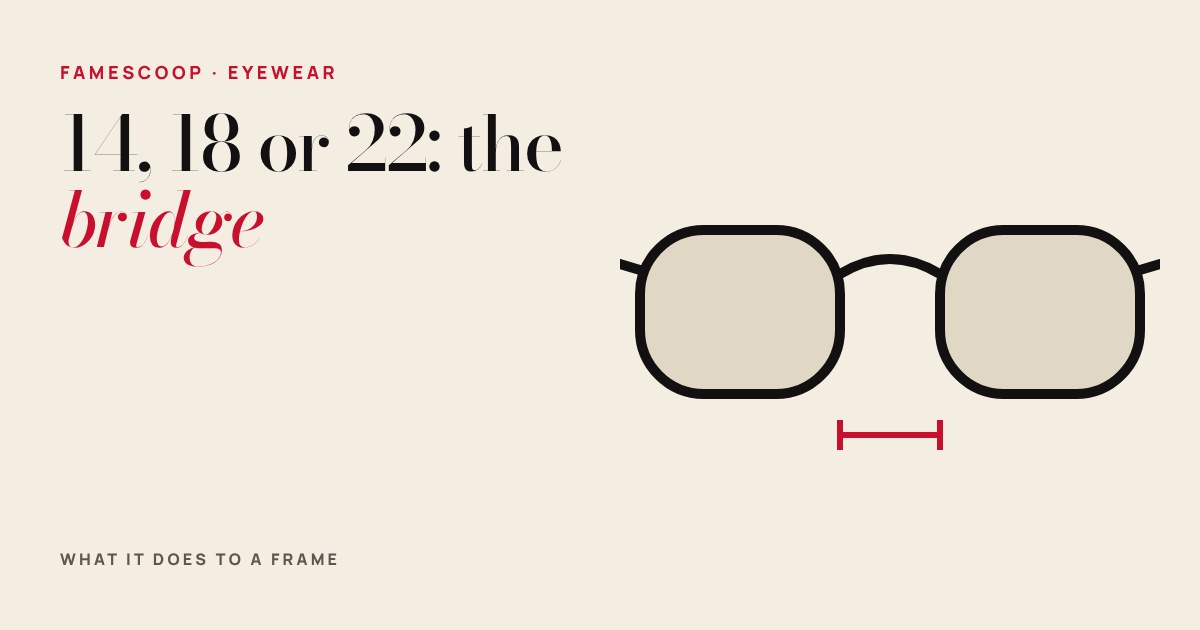
Turn a pair of sunglasses over and look inside one arm. There is usually a row of numbers, something like 54-18-145. Most people never read them. The middle one, 18 in that example, is the bridge: the gap in millimetres between the two lenses. It is the smallest number on the label and one of the quietest parts of a frame, yet it changes how a pair looks, how wide it is and how it sits when you wear it.
What the three numbers mean
The first number is the lens width, the horizontal size of each lens opening. The last is the arm length, from hinge to tip. The middle one is the bridge width, the distance between the lenses at the point where the frame connects them. Eyewear guides put the usual range at roughly 14 to 24 mm, so the whole story happens inside a 10 mm window, about the width of a fingertip.
That small window matters because the bridge sets the rhythm of the front of the frame. With two lenses of the same size, a narrow bridge pulls them together and a wide one spaces them out. Add the pieces up and you also get a rough front width: two lenses plus one bridge. Frames with 52 mm lenses and a 14 mm bridge measure about 118 mm across the lenses, and with a 22 mm bridge about 126 mm. The rims, hinges and end pieces add a little more, so treat it as a comparison rather than an exact figure.
What a narrow, standard or wide bridge does to a look
Narrow (around 12–16 mm). The lenses sit close together and read as one compact shape. This tends to look sharp and graphic, which is why it suits small round and pilot-style frames and a tailored outfit: a blazer, a crisp collar, a dark coat. Pair it with relaxed clothes and the frames stay the tidy part of the look.
Standard (around 17–20 mm). This is where most frames sit, and it is the safe middle. The two lenses read as a pair, and the frame does not shout either way. If you wear one pair with everything, it is usually here.
Wide (around 21–24 mm). More space between the lenses gives an open, easy look and a frame that spreads across the face. It suits oversized and square shapes, soft knitwear and loose layers. A very wide bridge on a small lens can look a little stretched, so it works best when the lenses are generous too.
The lens size sets the size of the frame. The bridge sets its mood.
Three ways to build a bridge
The same millimetres can be drawn differently. A saddle bridge is a simple curve between the lenses. It is the default on acetate and metal frames and looks clean with almost everything. A keyhole bridge is shaped like an arch with a rounded opening, common on acetate, and gives a softer, more vintage line. A double bridge adds a second bar across the top, the way many aviators are built. It works as a brow bar, a strong horizontal line that reads as a sharper, more retro look.
The bridge is also a fit part: it is where a frame rests. Metal frames often have small adjustable pads that an optician can tweak, while acetate frames usually have a fixed bridge, so the number matters more there. Fit is personal. Two frames with the same numbers can still sit differently, so if you can try a pair on, do. If you cannot, compare with a pair you already own and like: check its three numbers and shop for similar ones.
How to use this when you shop
Look at the label of a pair you wear a lot and write down the three numbers. Shop listings often give them as a size such as 54-18-145, so you can compare without seeing the frame. Then choose by the look you want. Want compact and sharp? Go narrower with a small or medium lens. Want relaxed and open? Go wider with a larger lens. Want something you can wear every day? Stay near the middle. And before you buy a new pair, check the wardrobe: sunglasses you already own that suit your clothes are always the cheapest option, and second-hand frames list their numbers too.
What to look for
- The middle number. Check the bridge width on the label or listing, not only the lens size. About 17–20 mm is the everyday middle.
- Bridge against lens. A narrow bridge looks best with small or medium lenses, and a wide one with larger lenses.
- The bridge style. A saddle is the easy default, a keyhole is softer and a double bridge is more graphic.
- Adjustability. If you have not tried a pair on, small adjustable pads on a metal frame give you more room to get the fit right.