One number on the arm decides how big the glasses look
Look inside the temple arm of a pair of sunglasses and you will usually find three numbers, such as 54-18-140. The first is the lens width in millimetres, measured across one lens at its widest point. The second is the bridge, the gap that sits on your nose. The third is the length of the arm. Most people shop by shape and colour and never read them, yet the first number does a lot of the work in how a pair looks with an outfit.
This piece is about that first number. It explains what small, medium and large lenses do to a look, shows you how to estimate the width of a frame against your own face, and ends with what to check before you buy.
Small, medium and large: what each one does
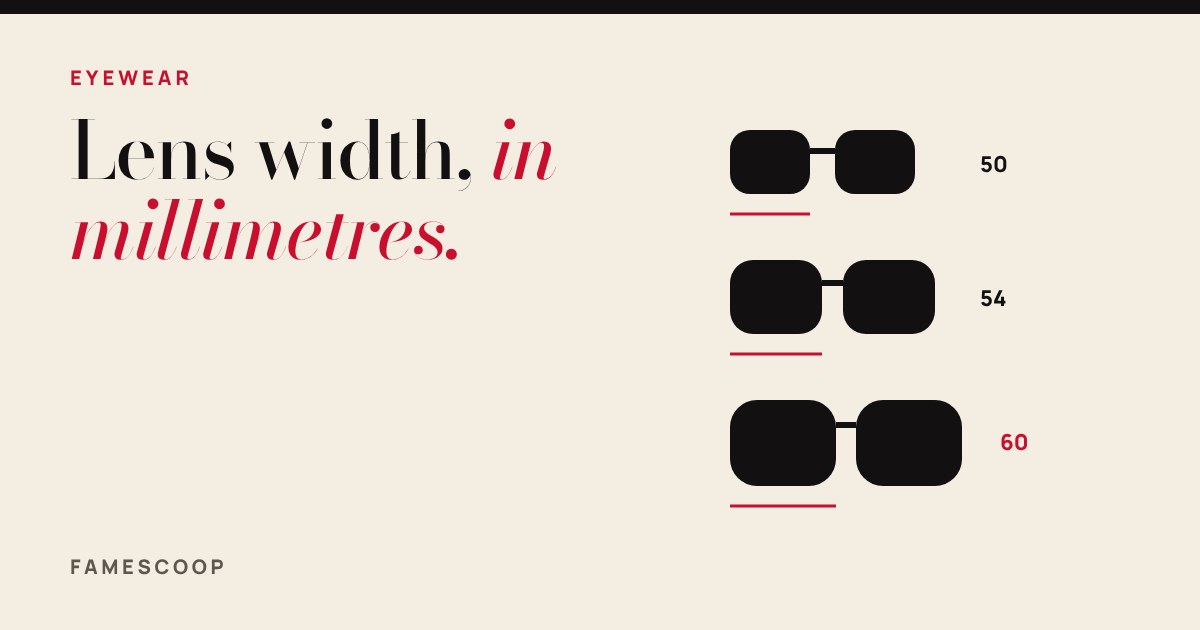
There is no official size chart, so treat these bands as a rule of thumb. Small lenses are around 48 to 51 mm. They look precise and a little vintage, and they keep the focus on the clothes. They suit sharp tailoring, a plain tee, a neat knit, anything where you want the glasses to be a detail rather than a headline.
Medium lenses are around 52 to 56 mm. This is the everyday range, the size most classic shapes are made in. Glasses this size are noticed but not discussed, which is why they work with almost everything.
Large lenses are 57 mm and up. They cover more of the face, so they read as a statement even in a quiet shape. They pair well with outfits that already have volume, such as a big coat, an oversized knit or a wide collar, because the glasses carry some of the same scale. Against a very slim outfit they can look like the only large thing in the picture, which is fine if that is the idea.
Pick the lens width the way you pick a hem: by how much of the picture you want it to take.
Try it: lens width against your face and your outfit
Set the lens width and the width of your face at the temples (a quick way to measure: hold a ruler across your face just above your ears, or take it from a pair of glasses that already fit you). The drawing shows the frame in proportion, and the numbers underneath show how it reads.
Match the width to the outfit
Start with the outfit's scale. If the clothes are close-fitting and clean, a small or medium lens keeps everything in proportion. If they are loose, layered or heavily collared, a medium or large lens stops the glasses looking too small for the picture.
Then check the frame against your face. A frame about as wide as your face looks calm. A frame a little wider looks relaxed. A frame much wider looks like a statement, and a frame much narrower can look pinched. None of these is wrong; they are different amounts of attention, so choose the one you want.
Last, remember that lens width is only half the picture. A tall lens and a short lens can share the same width, and the bridge decides where the glasses sit on your nose. Wearing a pair on, even for a minute, tells you more than the numbers do.
What to look for
- The three numbers. Lens width, bridge and arm length are printed on the frame or listed in the description. Note the ones from a pair that already fits you and use them as your starting point.
- Frame width against your face. Aim for about the width of your face at the temples, and go wider only if you want the glasses to lead.
- Scale of the outfit. Small lenses for fitted outfits, larger lenses for volume.
- UV protection. Look for a UV400 or 100% UV rating, which matters more than tint or price. Darker lenses without UV protection are worse than lighter lenses with it.
If you already own a pair you like, try it with each outfit before buying another: the right change is sometimes a different outfit, not a different size.