Huggie, Mid or Statement: What a Hoop's Diameter Does to an Outfit
A hoop earring draws a circle next to your face, and its diameter decides whether that circle is a quiet detail or the loudest thing in the outfit. Huggies, mid hoops and statement hoops each do a different job, and each sits differently against a collar, a neckline or loose hair.
Move the slider on a to-scale outline to see where a hoop starts to compete with what is around it, then learn what to check in a listing: the millimetres, the thickness and the closure.
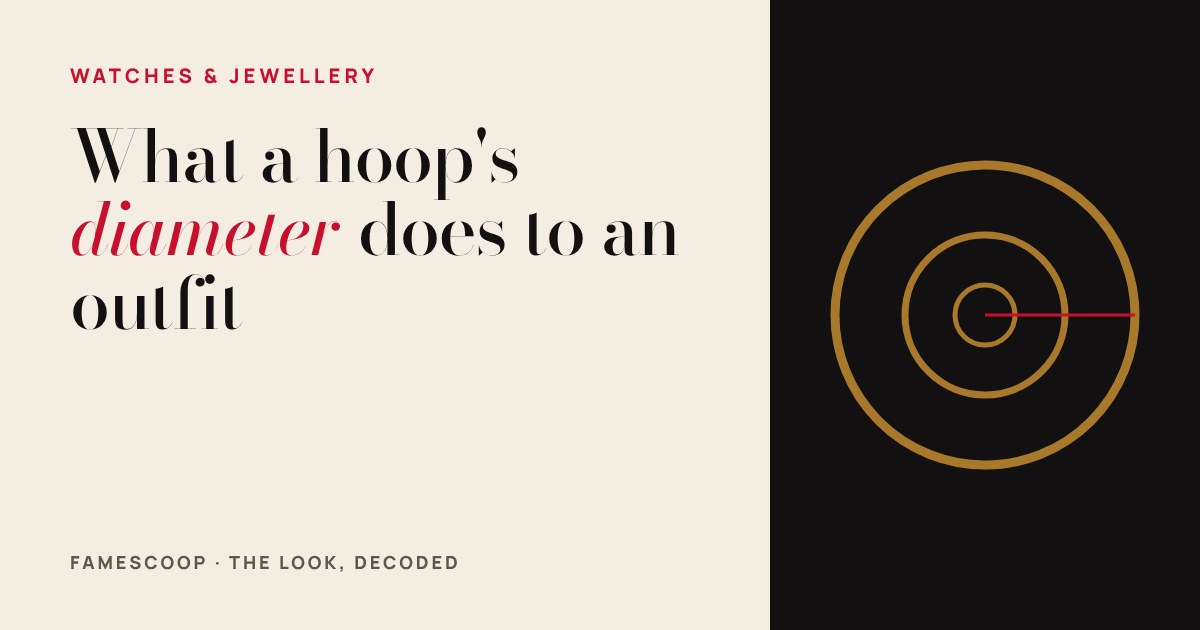
A hoop earring does one job above all others: it draws a circle next to your face. The size of that circle decides whether the earring reads as a quiet detail or as the loudest thing in the outfit. Nothing else about a hoop (metal, thickness, finish) changes the look as much as its diameter.
Three sizes, three jobs
Jewellers measure a hoop across the inside, in millimetres. The names vary from shop to shop, but the working ranges are consistent enough to learn: huggies are about 9–15 mm and hug the earlobe, mid hoops run from roughly 20 to 40 mm, and statement hoops start around 45 mm and go up to 65 mm or more.
A huggie is a point of light. It catches the eye when you turn your head but never competes with a neckline or a collar. A mid hoop is a clear shape: you notice the circle, and it frames the jaw. A statement hoop is a graphic element in its own right, closer to a hat or a scarf than to a small accessory, and the outfit around it has to make room.
Try the sizes on a neckline
The figure below is a plain, front-on outline, drawn to scale: one millimetre of hoop is one unit of drawing. Move the slider, change the neckline and switch the hair between up and down to see where a circle starts to compete with what is around it.
Why diameter beats everything else
Look at how little the other variables matter at a distance. A gold hoop and a silver hoop of the same size make the same circle; a thin tube and a thick tube make the same circle with a heavier or lighter line. Across a room, people read the outline first, and the outline is the diameter.
That is also why hoops are so easy to wear with almost any outfit: a circle is the most neutral shape there is. What changes is how much of the outfit it has to share space with. A plain tee, a sleek bun and a mid hoop is a complete look. A high-necked knit with a scarf and a statement hoop is two competing ideas.
Thickness: the second dial
Once you have the diameter, thickness is the fine adjustment. A 30 mm hoop in a thin wire looks delicate; the same 30 mm in a chunky tube looks twice as bold. As a rough guide, a tube of about 3 mm is a good middle: visible, but not heavy. Very thick hoops carry visual weight, so pair them with a slightly smaller diameter.
Pick the diameter for the outfit. Pick the thickness for the mood.
Wearing two sizes at once
Stacking works because the sizes are clearly different. A huggie in the lobe with a mid hoop in a second piercing creates a rhythm of small and large. Two nearly identical sizes look like a mistake. If you are unsure, keep a clear gap: at least 10 mm between the two diameters.
Matching a size to the occasion
For work or a long day, a huggie or a small hoop is the low-effort choice: it stays put, it does not catch on a scarf, and it looks finished. For dinner, a mid hoop does the same job with a little more presence. For a party or an event with a dress code, a large hoop with a simple dress works because the circle supplies the decoration, so the clothes do not have to. Reserve statement sizes for moments when you want the earrings to be the point, and wear them with the hair back so the full circle can be seen.
It also helps to think in terms of re-wearing. A single mid hoop in a metal you like will go with most of what you already own, which makes a second, more dramatic pair a decision you can take your time over. Second-hand shops and market stalls are a good place to try a size cheaply before committing to it.
What to look for
- The inside diameter in millimetres. Many listings give only "small", "medium" or "large", and those words mean different things to different makers. Look for the number.
- Weight and thickness. A large, hollow hoop can be very light, while a small solid one can feel heavy. Check the description if you plan to wear them all day.
- The closure. A hinged or snap closure is easier for everyday wear than a hook you have to thread.
- Your metal sensitivity. If your ears react to some metals, look for materials listed clearly, such as surgical steel, titanium or solid gold, instead of "alloy".
And if you already own a pair, try it against three different necklines before buying another. Often the pair you have just needs a different outfit, or a different hairstyle, around it.