Batons, Roman or Arabic: What a Watch's Numerals Do to an Outfit
A watch dial tells you the time and how formal the watch is meant to be. Batons are the neutral choice, Roman numerals lean dressy, and Arabic numerals lean practical and casual.
Build a dial in the interactive: pick a marking style, choose four or twelve marks, then test it against an outfit and see how closely they agree, plus how a strap can bridge the gap.
The dial is what you read, and what others read
A watch dial does two jobs. It tells you the time, and it tells everyone else how formal the watch is meant to be. Colour, case and strap all play a part, but the numbers (or the lack of them) do a lot of the talking, because they are the first thing your eye lands on when you check the time.
This piece compares the three marking styles you will meet on classic analogue watches: plain batons (thin sticks, also called indexes), Roman numerals and Arabic numerals (1, 2, 3). It explains what each one does to an outfit, shows the pairing in a drawing you can change, and says when to ignore the rule.
Batons, Roman and Arabic: what each one says
Batons are the neutral choice. A stick at every hour gives the dial a calm, even rhythm and nothing to read into. They sit equally well with a knit and jeans or a blazer and trousers, which is why so many "do everything" watches use them. The trade-off is that they say very little: a baton dial rarely makes an outfit more interesting, it just stays out of the way.
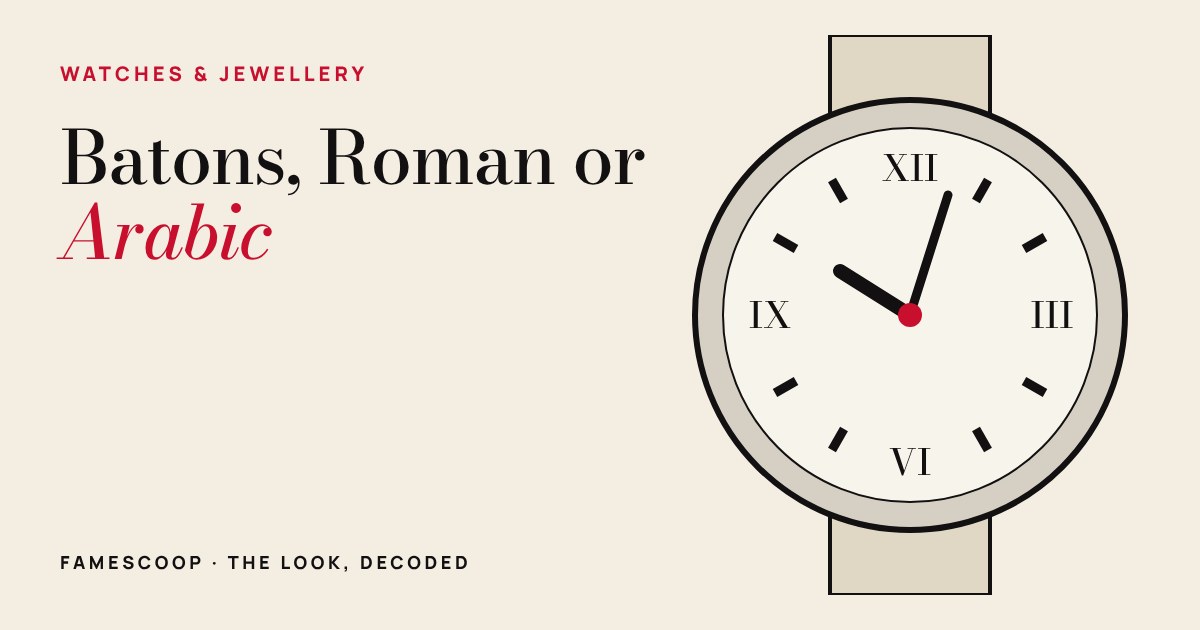
Roman numerals are the dressy choice. Their thick-and-thin strokes echo old printing and engraving, so they read as traditional and a little formal. Many Roman dials print four as IIII rather than IV, a long-standing convention that keeps the dial visually balanced against the VIII opposite it. Roman numerals suit tailoring, silk and evening wear. With a sweatshirt they can feel deliberately dressed up, which some people like and some find mismatched.
Arabic numerals are the practical choice. Plain, large digits are quick to read, which is why field and pilot-style watches use them. They pull an outfit towards casual and utilitarian: canvas, denim, chunky knitwear, trainers. On a very formal outfit they can look like the wrong tool for the job, though a slim dial with small, light digits stays surprisingly smart.
Numerals set the tone before the strap or the case does.
Try it: build a dial and test it on an outfit
Choose a marking style, then how many marks show (four at 12, 3, 6 and 9, or all twelve), then the outfit. The scale underneath shows where the dial sits from relaxed to dressy, and a marker shows where the outfit sits. The closer they are, the easier the pairing.
How to choose without overthinking it
Start with what you wear most. If your week is mostly jeans, knitwear and trainers, Arabic numerals or batons will never look out of place. If it is mostly tailoring, shirts and dresses, Roman numerals or slim batons are the safer match. If it is a mix, batons are the one dial that does not need a decision.
Then look at how busy the dial is. Four numerals with dots or short batons in between looks cleaner than twelve large numerals, and it works with patterned clothes because the dial is not competing with the print. Twelve numerals look fuller and more traditional, and suit plain fabrics better.
Finally, let the strap do the bridging. A Roman dial on a canvas strap is a relaxed, slightly ironic look. An Arabic dial on a thin leather strap is a smart one. Changing a strap costs far less than changing a watch, and it moves the whole watch along the scale above.
What to look for
- Legibility first. Numerals should contrast clearly with the dial. A watch you have to squint at will look fussy however good the style.
- A size that fits the dial. Numerals that crowd the edge or the hands look cheap. Space around each one looks considered.
- One idea per dial. Large numerals, a date window, a bright colour and a textured pattern together is a lot. Pick the one thing you want the dial to say.
- A strap that agrees. Leather for dressier numerals, canvas or steel for plainer ones, and the whole watch will look like a single decision.
If you already own a watch, try it against three outfits before buying another. Second-hand watches are a sensible way to try a dial style for less, and a different strap is often all it takes.