Which Necklace Length for Which Neckline: A Chain-and-Neckline Matcher
A chain doesn't float on its own: it sits against a neckline, and the gap between the two decides whether the look seems planned or accidental. Pick a neckline in the matcher below, drag the chain length in centimetres, and see where it lands.
The rule it shows is simple: sit clearly inside the opening or clearly on the fabric, and avoid the near miss. Plus a plain guide to choker, princess, matinee, opera and rope lengths and what each does with a crew neck, scoop, V, boat neck, collar or roll neck.
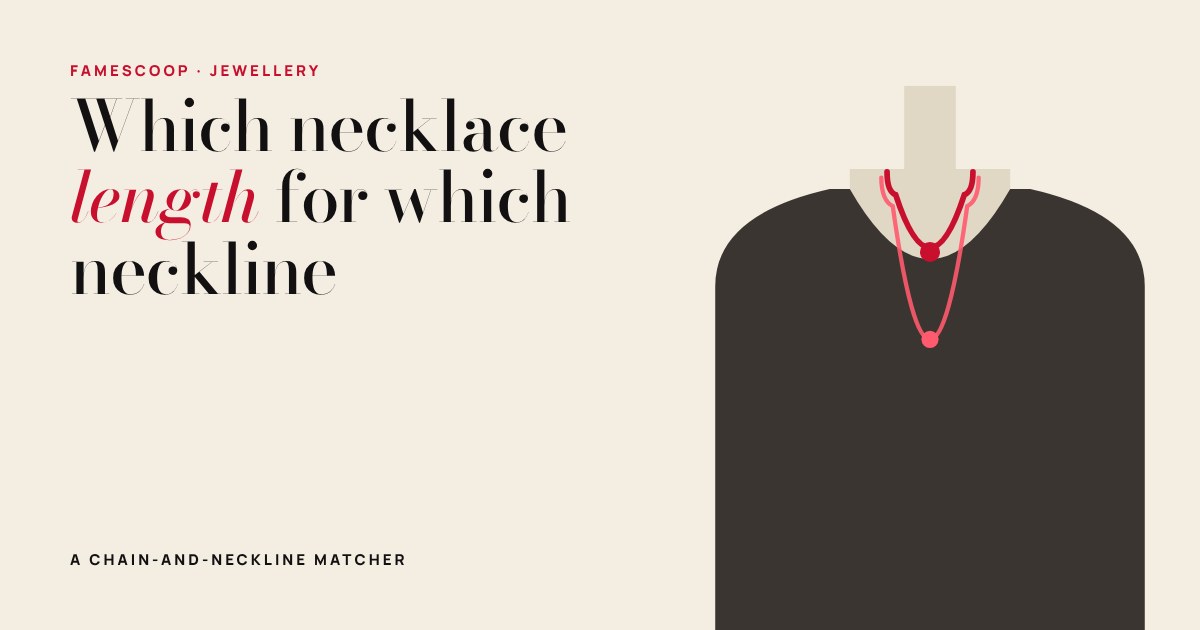
A necklace is a neckline decision
Most people choose a necklace by how it looks in the box. It is worth choosing by what it sits against. A chain does not float on its own: it is drawn on top of a collar, a scoop, a V or a roll of knit, and the distance between the chain and the edge of that neckline decides whether the two look planned or accidental.
That distance is mostly one number: the length of the chain. Below is a small matcher. Pick a neckline, drag the length, and see where the chain lands against it.
The five lengths, in centimetres
Jewellers use a set of named lengths. Makers vary by a few centimetres, so treat these as the common conventions rather than a standard.
| Name | Length | What it does |
|---|---|---|
| Choker | 35–40 cm | Sits close, high, usually above any neckline |
| Princess | 43–48 cm | The everyday length, just below the base of the neck |
| Matinee | 50–60 cm | Lands at or below a crew neckline, fills a V |
| Opera | 70–90 cm | Hangs over the chest, can be doubled |
| Rope | 90 cm and up | Long enough to loop twice or knot |
The near-miss rule
A chain has two comfortable positions against a neckline. It can sit clearly inside the opening, well clear of the lowest point of the edge, so the neckline reads as the frame and the chain as a separate line. Or it can sit clearly below, so the chain lies on the fabric and the neckline is just the backdrop.
The awkward position is the near miss, where the chain brushes the edge: close enough to look like it is trying to match, far enough that it does not. A gap of roughly two to three centimetres either way is where this usually starts to look accidental. The matcher marks that zone for you.
Pick a side. The chain is either inside the opening or on the fabric, never touching the edge.
Neckline by neckline
Crew neck
The round edge sits close to the base of the neck, so a choker clears it from above and a matinee length lands cleanly on the fabric. The in-between princess length is the one most likely to graze the seam. If you wear a tee all year, a single fine chain at matinee length is the easy answer.
Scoop
The scoop is a curve, so the chain wants to echo it. A princess length drawn inside the scoop repeats the shape; a pendant that sits just inside the lowest point looks deliberate. Past opera length the chain starts to ignore the neckline altogether, which is fine if you want it to.
V neck
A V points somewhere, and a pendant can point to the same place. A chain with a drop that finishes a little above the tip of the V makes the two shapes rhyme. A chain that ends at the tip, or crosses the V edge, is the near miss.
Boat neck
A wide, shallow neckline leaves a long horizontal line across the shoulders of the garment. A choker or a short princess chain sits above it cleanly; a matinee length sits below with a pendant. Little in between works.
Collar
A shirt or polo collar already has two strong lines. Short chains tend to fight the collar points. Either tuck a fine chain under the collar so only a glint shows, or go long enough to hang well below the placket.
Roll neck
The knit already fills the space where a short chain would sit, and a choker presses into the fold. Go long: a matinee or opera chain hangs over the knit as a clean vertical line. This is where long chains earn their place in autumn and winter.
Layering without a tangle
Two chains look best when their lengths differ by about five to eight centimetres, enough that each one is its own line. Make one of them plain and keep the other as the interesting one (a pendant, a heavier link). Same metal tone is the easy route; mixing gold-tone and silver-tone works when one piece is clearly in charge.
A quick check before you leave
- Where is the chain against the edge? If it is within a couple of centimetres, change the length or the top.
- Does the pendant point somewhere? Let it point at something: the V tip, the centre of a scoop, the placket.
- Is the knit thick? Thick fabric needs a longer, heavier chain to read at all.
- Do you own an extender? A small extender chain turns one necklace into two lengths and costs very little.