Patch, Flap or Welt: What a Coat's Pockets Do to an Outfit
A coat's pockets sit at the widest point of the outfit, so they shape the line from the side and decide whether it looks composed or relaxed.
Welt, flap and patch pockets each do something different: one keeps the outline clean, one adds a gentle horizontal line, one adds visible volume at the hip. Try all three on a coat, move the pocket up and down, and fill it to see what changes.
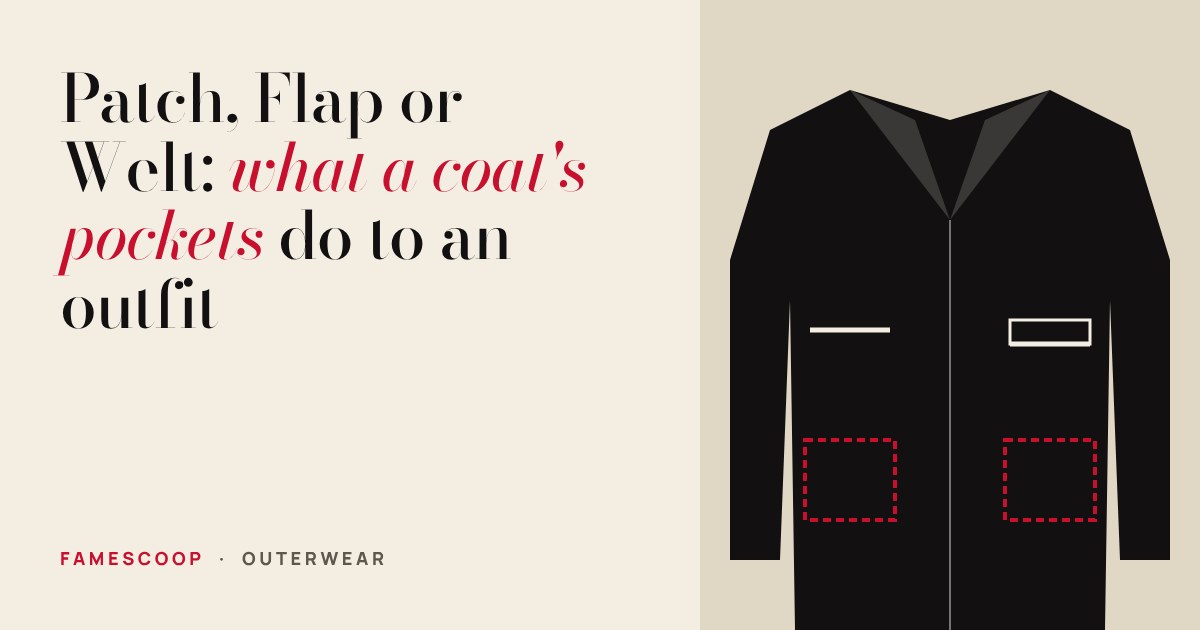
The part of a coat your hands notice first
A coat's pockets are easy to overlook in a shop and impossible to ignore once you wear it. They sit at the widest point of the outfit, right where your hands go, so they decide two things at once: the line the coat draws from the side, and how relaxed or sharp it looks when you walk.
There are three constructions to know. A welt pocket is a slit cut into the fabric and finished with a narrow strip along the edge, so almost nothing sits on the surface. A flap pocket is that same slit with a flap of fabric hanging over the opening. A patch pocket is a separate piece of fabric sewn onto the outside of the coat, like a small square or rectangle you can see from across the street.
Welt: the clean line
If a coat looks sleek in photos, there is a good chance it has welt pockets. With no flap and no patch, the eye travels straight down the front, so the coat looks longer and more serious. That is why welts show up on tailored coats, minimal overcoats and dressier wool styles.
The trade-off is practical. A welt opening is narrow and sits close to the body. Put a phone in it and the shape shows straight away. Treat these pockets as places for your hands and a glove, not for a bulky load.
Flap: the sensible default
A flap pocket is a welt with a lid. The extra layer of fabric gives the hip a gentle horizontal line, and it covers the opening so that weather stays out. Trench coats and a lot of everyday wool coats use it for that reason.
The flap is also flexible. Tucked in, the pocket looks nearly as clean as a welt. Hanging out, the coat looks easier and a little more casual. If you own a coat with flaps and it feels too stiff, try leaving them out for a day.
Patch: the casual statement
A patch pocket is stitched on the outside, so it is the only one of the three that adds real volume. It makes the lower half of a coat look wider and more relaxed, which works well with chunky knitwear, wide trousers and boots. The look comes from the workwear and military side of outerwear.
Because it sits proud of the surface, it is the pocket that carries a load best. A phone looks natural in a patch pocket in a way it never does in a welt.
The pocket you choose tells people whether the coat is meant to look composed or lived in.
Where the pocket sits matters as much as the type
Move the slider in the figure and you can see it. A pocket placed higher shortens the coat visually; one placed lower makes the torso look longer. Most well-cut coats put the opening roughly where your hand lands when your arm hangs naturally. If you can only reach it by bending your elbow, it is too high; if you have to reach behind your hip, it is too low.
Check this when you try a coat on. Let your arms hang, then slide your hands into the pockets without leaning. They should arrive without effort.
What to look for
- Match the pocket to the job. Welt or tucked flap for a coat worn over tailoring; patch for a coat you want to look easy.
- Test the reach. Hands should slide in with the arm hanging relaxed.
- Check how it sits when full. Fill the pockets with what you really carry. If the line bulges, either carry less or choose a pocket that copes with the load.
- Look at the lining. A pocket bag in a smooth lining feels better against the hand and keeps the shape longer.
None of this needs a new coat. Tuck the flaps in, empty the pockets, or move your phone to a bag, and the coat you already own will look different.