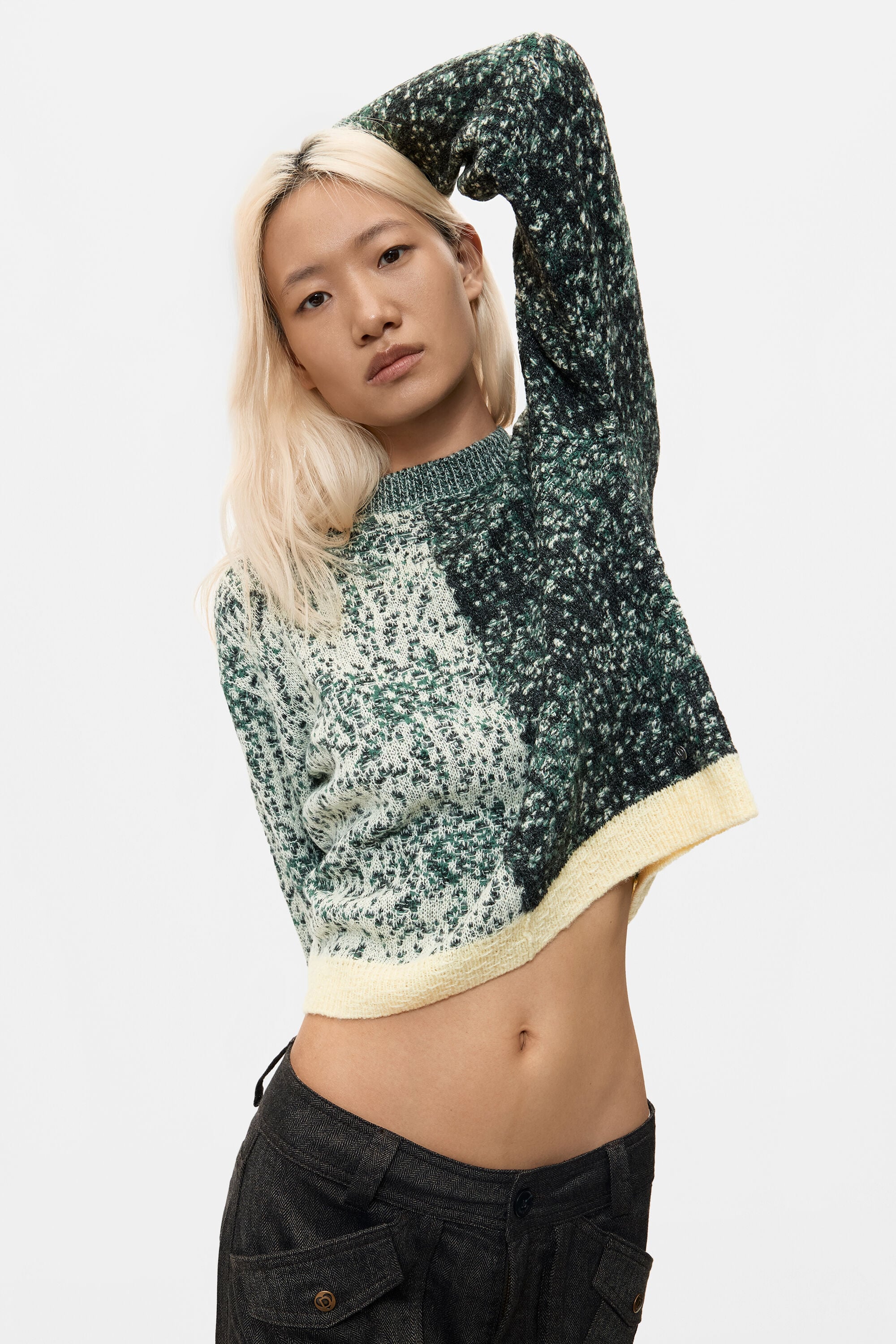
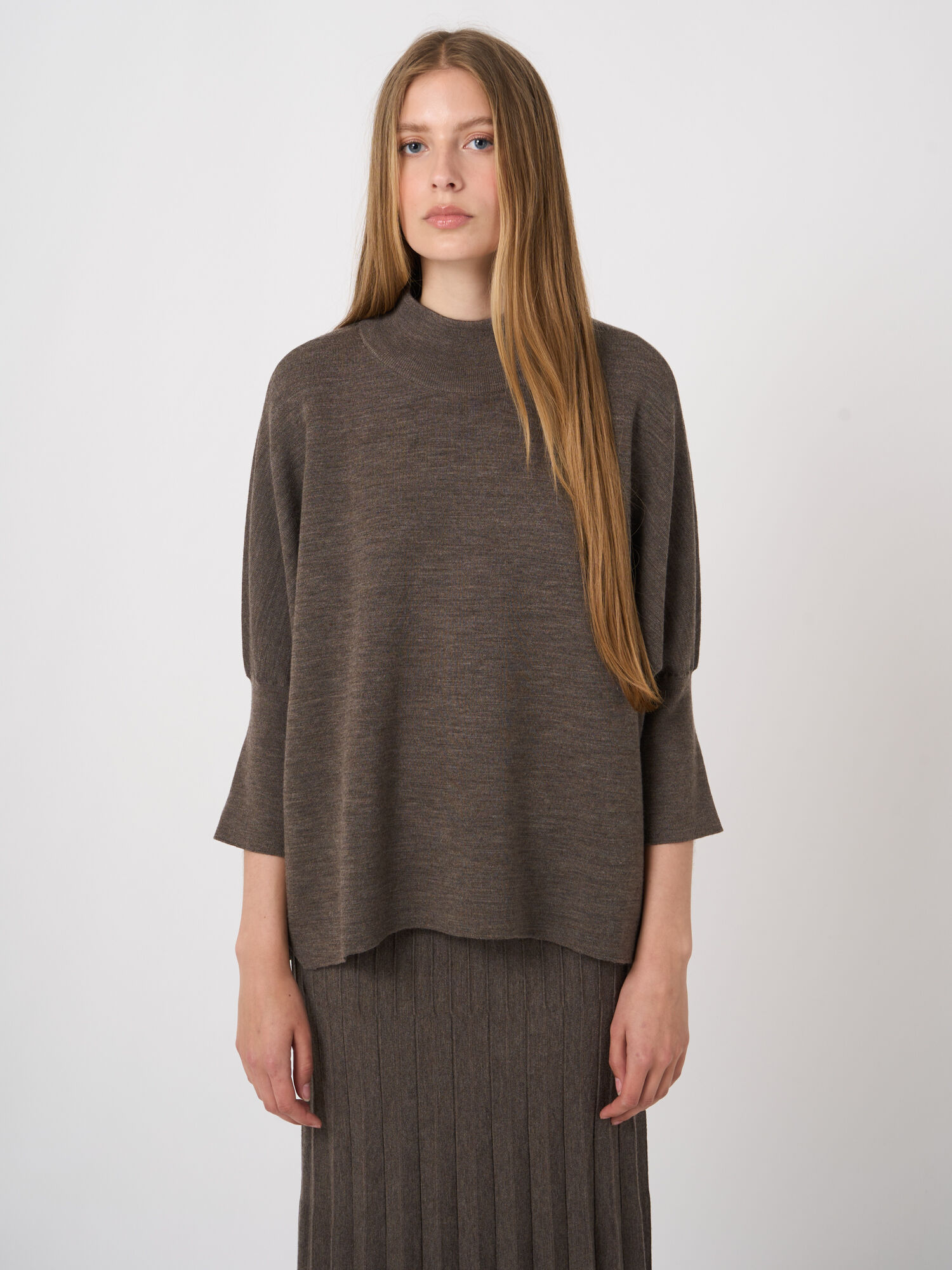
Two sweaters can share a colour, a neckline and a size label and still behave like different garments. The difference is the knit itself: how thick the yarn is and how tightly it is worked. Knitters call this the gauge. More stitches per centimetre means a finer, thinner fabric. Fewer, bigger stitches mean a chunky one. It decides what you can wear over the sweater, what you can wear under it, and how the whole outfit holds its shape.
What gauge changes
A fine knit is thin, lies flat and drapes. It slides under a shirt collar or a blazer without adding bulk, and it keeps the line of whatever sits on top of it. A mid-weight knit is the everyday jumper: it has some body and some texture, and it works as the top layer on its own or under an open coat.
A chunky knit is thick and holds its own shape. It adds volume at the shoulders, chest and cuffs, so it is almost always the outer layer of an outfit and the loud one in it. The usual pairing is a chunky top with something slimmer below: a straight trouser, a plain skirt, a simple boot.
Why the sleeve is where it shows
The quickest way to see what gauge does is to look at the sleeve. An arm, a shirt cuff and a knit all have to fit inside the sleeve of the jacket on top. A fine knit adds under a centimetre to the distance around the arm. A chunky one can add close to five. That is enough to make a jacket you love feel tight at the elbow, ride up at the shoulder, or refuse to button over the chest.
The diagram above uses a simple rule: a sleeve is comfortable when it has about 6 cm of spare room around the layers inside it, snug at 3 to 6 cm, and tight below that. Nothing official sits behind those numbers. They are a convenient way to think about it, and you can test them with a jacket and a ruler.
The thicker the knit, the more the outer layer has to give, so size up the layer on top, not the sweater underneath.
Three outfits, three weights
Fine knit as the quiet base
Wear it under a shirt with the collar out, under a blazer, or alone with trousers when you want a clean line. Because it is thin, it shows the fabric underneath it, so a smooth surface and an even colour look sharpest. Fine knits are also the easiest to layer twice: a fine crew neck under a mid-weight cardigan is a classic way to add depth without bulk.
Mid-weight as the everyday layer
This is the one most people own. It works under an open overcoat with room to spare, and it is thick enough to carry texture such as ribbing or a subtle cable. If you only buy one knit this season, a mid-weight one in a neutral colour gives you the most outfits for the least fuss.
Chunky knit as the statement
Let it be the statement piece and keep everything around it simple. Put it under a coat that is cut generously, or wear it as the outer layer and skip the coat on milder days. A chunky knit already gives your outfit its volume, so a slim hem, a straight leg and a plain shoe finish it off. Use a high neck or a rolled collar and you may not need a scarf at all.
What to look for
- Stitch size you can see. Hold the knit to the light. If you can count individual stitches from arm's length, it is chunky. If the surface looks almost smooth, it is fine.
- Fibre content. Wool, merino and cashmere make good thin knits that still keep you warm. A knit with a lot of acrylic can pill sooner, so check the label.
- Ribbed cuffs and hem. Tight rib at the cuff and hem lets a thick knit sit neatly and stops it stretching out of shape.
- Room in the layer on top. Try the sweater with the coat or blazer you plan to wear over it. If the sleeves feel tight, change the layer on top, not the knit.
If you already own a knit you like, wear it with a different layer first. A coat you have never worn over it might fit better than you expect, and nothing new is needed.