Staggered Hems: How Far Apart Should Your Layers Sit?
Two hems that almost match look like a mistake; two that sit clearly apart look planned. This piece explains why the gap between layers matters more than their lengths, and gives you a builder to test a tee, knit and coat.
Set each hem in centimetres below the natural waist, drag the dots, and see whether your stack reads as accidental, even or deliberate. You also get a simple gap guide and a few ways to fix a clash using clothes you already own.
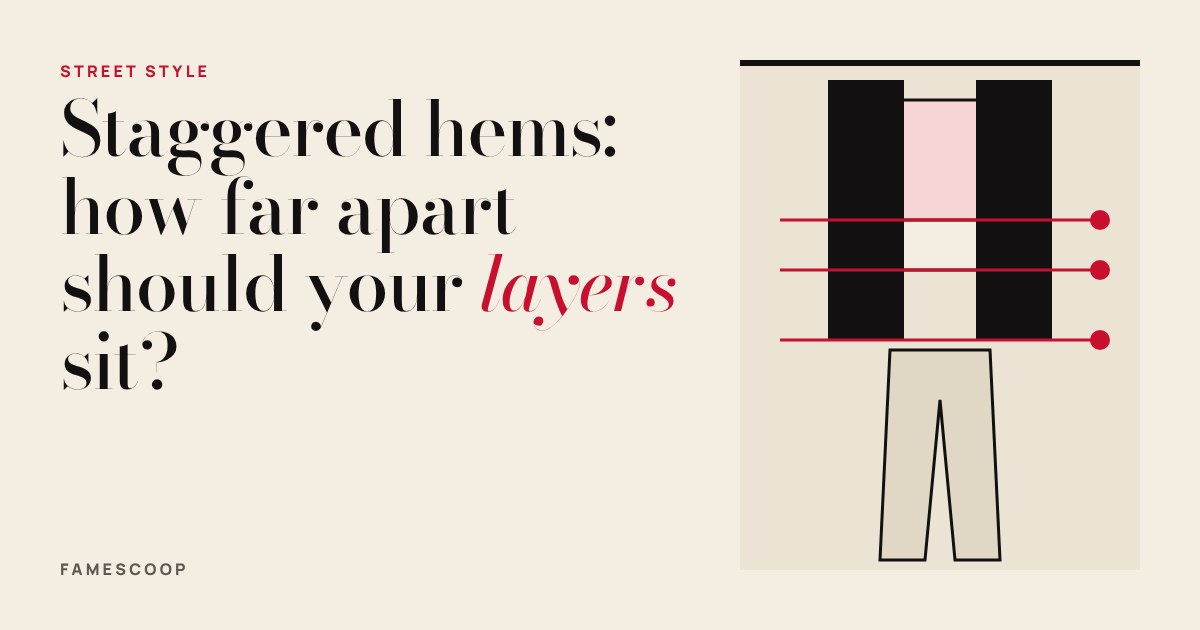
Take a tee, a knit and a coat. Wear them together and three hems appear at three heights. Most people never choose those heights; they are simply wherever the clothes happen to end. That is why the same three pieces can look planned on one day and accidental on the next.
Why almost-matching hems look like a mistake
The eye reads a hem as a horizontal line. Two lines that sit very close together look like one line that went wrong: a shirt that rode up, a jumper that shrank. Two lines that sit clearly apart look like a decision. The distance between them matters more than the lengths themselves.
This is a rule of thumb from styling practice, not a measured law, and the numbers below are a starting point you can test on your own clothes in a mirror.
Try your own layers
Switch layers on and off, then drag the red dots (or use the sliders) to set where each hem ends, in centimetres below your natural waist, the narrowest part of your middle. Measure a real tee, knit and coat from the waist seam down if you want a true read.
The gap guide
| Gap between hems | What it usually reads as |
|---|---|
| Under 3 cm | Accidental: one layer looks like it slipped |
| 3–8 cm | Deliberate, a quiet peek of the layer below |
| 9–15 cm | Bold, easy to see from across a room |
| Over 15 cm | Two separate shapes rather than one layered outfit |
Even steps or uneven?
Two gaps of exactly the same size look tidy and a little formal, like a staircase. Gaps that differ by a few centimetres feel looser and more relaxed. Neither is wrong; choose by mood. A tailored coat over a fine knit suits even steps. A big cardigan over a tee suits uneven ones.
Choose the gap, not the length: the space between two hems says whether it was planned.
How to adjust what you already own
You rarely need new clothes to fix a hem clash. Three small changes cover most cases.
- Fold or tuck. Rolling a tee hem up once, or tucking it in a few centimetres at the front, moves it a few centimetres without buying anything.
- Swap the top layer. A longer or shorter coat changes both gaps at once, so try the other coat first.
- Move one hem a long way. If two hems are within 2 cm, do not nudge one by 1 cm. Move it at least 4 cm so the difference is clearly visible.
When to break the rule
Matching hems on purpose also works, as long as they truly match. A knit and a shirt cut to the same length can look like one piece, which is a valid look. Long coats are another exception: when the coat covers everything beneath it, the inner hems no longer show and only the coat's hem matters. And a heavily textured knit can hide a small gap, so check by eye rather than by tape alone.
Fabric changes the read too. A thin cotton tee under a thick wool knit drapes differently, so measure when the clothes are worn, not flat on a bed.